Michelangelo and Mercedes Matter: The Afterlife of Disegno
To place Michelangelo and Mercedes Matter in direct comparison is to trace an extraordinary arc through the history of Western drawing. Michelangelo stands at the height of the Florentine Renaissance, when disegno was understood not merely as draftsmanship but as the intellectual foundation of artistic creation. Mercedes Matter, working more than four centuries later in the environment of Hans Hofmann, the New York School, and Abstract Expressionism, inherited a radically altered conception of pictorial space and gesture. Yet in her red-chalk figure drawings of circa 1968–70, she returned to the human body with a seriousness that makes the distance between the two artists unexpectedly productive. Matter’s achievement lies not in imitating Michelangelo but in carrying forward the central logic of his draftsmanship into a modern visual language. In both artists, the figure becomes more than a subject: it is the structure through which movement, pressure, thought, and pictorial invention become visible.
This relationship becomes especially compelling when Matter’s reclining red-chalk figure is considered beside Michelangelo’s Studies of a Reclining Male Nude, circa 1511, in the British Museum. Executed in red chalk on paper, Michelangelo’s sheet presents the male body as an interlocking system of weight, torsion, and counter-movement. The torso bends backward, the raised leg folds sharply upon itself, and the extended arm creates a long lateral thrust across the sheet.
Michelangelo moves between fine hatching, soft modeling, and reinforced contour so that the figure seems almost sculpted rather than drawn. The body is not simply described; it is constructed. Its power derives from the concentration of force within anatomy, as each limb and muscular passage contributes to an extraordinary sense of physical unity.For Michelangelo, this process was central to the Florentine idea of disegno, in which drawing joined hand and mind. The first contour was not necessarily final; it could be adjusted, strengthened, or reconsidered as the artist searched for a more convincing structure. In Studies of a Reclining Male Nude, that search ultimately moves toward consolidation. Repeated contours and modeled passages strengthen the body’s mass, while the raised thigh, twisting abdomen, and extended arm create a closed circuit of tension. Michelangelo’s figure is fundamentally centripetal: its energies gather inward, and the surrounding paper remains subordinate to the bodily drama.
Matter begins from a remarkably similar premise. Her red-chalk drawing of circa 1968–70 also presents the reclining body as a system of opposing forces. The figure is built through overlapping limbs, repeated contours, and changes in pressure, while lighter and heavier marks reveal successive acts of looking. Like Michelangelo, Matter refuses the simplicity of a single enclosing line. Yet where Michelangelo’s revisions tend toward anatomical coherence, Matter’s begin to destabilize it. A contour may start as the edge of a limb and continue beyond the body; a diagonal originating in the torso becomes an independent pictorial vector; a repeated line introduces not greater certainty but another spatial possibility.
Placed beside one another, the two sheets make the essential distinction clear: Michelangelo compresses force into the body; Matter releases that force from the body into the surrounding field. Michelangelo’s searching line repeatedly returns to anatomy, reinforcing the body’s sculptural presence. Matter’s line begins with anatomy but moves outward, converting the figure into a larger spatial armature.
Mercedes Matter Untitled, c. 1968–70, red chalk on paper
Placed beside one another, the two sheets make the essential distinction clear: Michelangelo compresses force into the body; Matter releases that force from the body into the surrounding field. Michelangelo’s searching line repeatedly returns to anatomy, reinforcing the body’s sculptural presence. Matter’s line begins with anatomy but moves outward, converting the figure into a larger spatial armature. A thigh becomes both a thigh and a diagonal; a shoulder becomes both a bodily joint and a point of directional pressure; the figure becomes not simply something occupying space but the structure through which space is generated. Matter does not reach abstraction by abandoning the body. She discovers abstraction through it.
This transformation places Matter in a distinctive position within the history of Abstract Expressionism. By the late 1960s, the meaning of the mark had changed profoundly. Cézanne had destabilized the continuity of form, Cubism had fractured pictorial space, Hofmann had conceived space through dynamic relationships of pressure and interval, and Abstract Expressionism had granted gesture an unprecedented autonomy. Matter absorbed these developments but refused the assumption that modernity required the disappearance of the figure. Instead, she used observation as the basis for abstraction, allowing the human body to generate the rhythms, tensions, and directional forces of the entire sheet.
Hans Hofmann’s influence is crucial to this process. Matter understood from Hofmann that visual experience had to be reconstructed rather than passively copied. At the New York Studio School, which she founded in 1964, sustained looking and continual revision became central to her teaching. She often drew in front of students, making visible the process by which an image could be tested, corrected, and rebuilt. In this respect, her practice shares a deep affinity with Renaissance disegno: drawing advances through reconsideration. But Matter changes the meaning of correction. In Michelangelo, a revised contour often strengthens anatomical certainty. In Matter, multiple contours may remain active together, preserving the instability of perception itself.
This gives Matter’s drawing a temporal dimension. One line records one moment of seeing; another records a later adjustment. The final image retains these successive acts rather than suppressing them. Michelangelo’s drawings also preserve evidence of process, but they tend toward the monumental unity of the body. Matter allows process to remain open, making revision itself part of the completed work. In this sense, her red-chalk figures participate directly in the language of Abstract Expressionism, where the history of making—pressure, hesitation, correction, and movement—can remain inseparable from the final image.
The shared use of red chalk makes the comparison especially powerful. In Michelangelo’s hands, sanguine carries associations of flesh, intimacy, and sculptural modeling. In Matter’s, those associations survive but are radically transformed. Her chalk is dragged, pressed, rubbed, broken, and layered; the warmth of the medium continues to suggest the body, but bodily form increasingly merges with gesture and space. Contour becomes action, modeling becomes pressure, and anatomy becomes structure. Matter is therefore not abstracting away from the figure but abstracting through it.
Michelangelo’s Studies of a Reclining Male Nude provides an ideal counterpoint because his figure is already conceived as a system of forces. The bent leg, twisting torso, and extended arm organize the body into a monumental pictorial structure. Matter begins with the same fundamental problem but carries it beyond anatomical containment. What Michelangelo organizes within the figure, Matter distributes across the sheet. His anatomical tension becomes her spatial tension; his concentrated body becomes her expanded field. The distinction can be stated simply: Michelangelo’s figure occupies space; Matter’s figure generates it.
Seen in this way, Matter can be understood as one of the final modern extensions of the Michelangelesque tradition. This does not imply direct imitation. She does not reproduce Michelangelo’s forms or attempt to restore Renaissance draftsmanship after modernism. Rather, she carries forward the deeper intellectual structure of disegno: the belief that drawing is a means of discovery, that the body can serve as the primary site of pictorial intelligence, and that the movement of the hand can record the movement of thought. Michelangelo searches for the body through line; Matter searches through the body toward space.
The pairing of these two drawings makes that progression especially compelling. Michelangelo’s reclining figure folds inward, its muscular energies compressed into a coherent bodily unity. Matter’s reclining figure begins with comparable compression but allows its contours to escape, extending line and movement across the paper. The similarity establishes the continuity; the difference establishes Matter’s modernity. Between them lies the history of modernism, yet both remain founded on the same conviction that the human figure, subjected to sustained observation and the searching intelligence of the hand, is an inexhaustible structure.
Mercedes Matter can therefore be understood not simply as a late practitioner of figurative red-chalk drawing but as one of its most compelling twentieth-century culminations. Michelangelo transforms the observed body into monumental form; Matter transforms it into spatial energy. The searching contour becomes gesture, anatomical tension becomes pictorial tension, and the Renaissance figure expands into the Abstract Expressionist field. In Matter’s work, the ideal of disegno does not disappear. It survives modernism and reaches a new conclusion: the body remains the origin of the drawing, but its force can no longer be contained within its own boundaries.
-

LUCIA WILCOX
LUCIA WILCOX - HITTING THE BOILING POINT 20 Sep - 30 Oct 2024 Hitting the Boiling Point: Works from 1942 to 1962 offers an in-depth exploration of Lucia Wilcox’s artistic development over two critical decades. Featuring key works that chart her evolution from surrealist-inspired landscapes to the bold, gestural abstractions of her later career, this exhibition captures the creative force that defined Wilcox's unique contribution to mid-20th century American art. Each of the pieces selected for this show provides insight into the intensity, emotion, and technical mastery that Wilcox brought to her practice, as well as the wider artistic movements she engaged with throughout her career.
Early Surrealist Influences: Dreamscapes and Metaphor
The exhibition opens with works from the early 1940s, which reveal Wilcox’s engagement with surrealism and her deep fascination with nature as a metaphor for the human experience. A standout piece from this period is Untitled (1945), a vibrant landscape where the trees, foliage, and sky seem to merge with fantastical creatures and human forms. The painting depicts a long green pathway leading into an ethereal horizon, flanked by anthropomorphic trees and dreamlike figures. This work demonstrates Wilcox’s early experiments with surrealist elements, where the boundaries between human, animal, and landscape are blurred.
The dreamlike quality of this early work aligns Wilcox with the European surrealist movement, which found a temporary home in America during the 1940s due to the displacement of artists caused by World War II. The recurring motifs of trees, pathways, and birds in her surrealist works serve as both literal and metaphorical elements—depicting the natural world while symbolizing psychological or spiritual journeys. The vibrant colors in these early works—rich blues, greens, and purples—contribute to the otherworldly atmosphere, inviting viewers into Wilcox’s uniquely imagined landscapes.
Emotional Abstraction: The 1950s
By the early 1950s, Wilcox began to transition from surrealist dreamscapes to a more abstract visual language, incorporating the emotional intensity of the abstract expressionist movement. This shift is most evident in works like Untitled (1959), where her use of bold, sweeping brushstrokes dominates the composition. In this particular work, her palette shifts to monochromatic blacks, whites, and grays, which reflect a deep engagement with light, form, and movement. The painting is characterized by thick arcs of white paint set against a dark background, a technique that evokes the dynamic tension between control and spontaneity.
Wilcox’s brushwork in these later paintings speaks to the physicality of her process. The large, gestural strokes suggest a performative element in her painting, where the act of creation becomes as significant as the final image. The textured surface of these works, achieved through the layering of thick paint, gives them a sculptural quality that extends beyond the two-dimensional plane of the canvas. These pieces align with the abstract expressionist movement’s focus on the artist’s emotional state and their immediate, raw interaction with the materials.
The 1960s: Bold Gestures and Monochrome Intensity
The works from the early 1960s, such as Untitled (1961), represent the culmination of Wilcox’s transition into full abstraction. In these pieces, her earlier surrealist sensibilities give way entirely to an exploration of form, movement, and texture. The painting features large, sweeping arcs of white that slash across a dark, monochromatic background. The tension between the whites and blacks creates a dramatic interplay between light and darkness, reinforcing the emotional intensity that defines this period of her work.
Wilcox’s 1960s paintings are deeply connected to the ethos of abstract expressionism. The physicality of her brushstrokes and the emphasis on spontaneity link her to the action painting of Jackson Pollock and Franz Kline, although Wilcox’s work remains deeply personal and introspective. The use of monochromatic colors in these works strips away the distraction of color, allowing the viewer to focus entirely on the gesture and texture of the paint. In works such as these, Wilcox achieves a balance between chaos and control, where bold, aggressive strokes contrast with more restrained, meditative areas of the canvas.
Thematic Continuities: Nature, Emotion, and Spirituality
Despite the evolution of her style, certain themes persist throughout Wilcox’s oeuvre, linking her surrealist landscapes of the 1940s with her abstract works of the 1960s. One of the most enduring themes is her engagement with nature, not as a literal subject but as a metaphor for deeper emotional or psychological states. In her earlier works, nature is depicted through trees, birds, and paths, symbolizing growth, transformation, and spiritual journey. As her work becomes more abstract, this connection to nature remains, albeit more subtly—expressed through organic shapes, fluid gestures, and the dynamic interplay between light and shadow.
Wilcox’s deep emotional engagement with her work also transcends the stylistic shifts seen across these decades. Whether through the symbolic figures in her early landscapes or the raw energy of her later abstractions, her work consistently explores the emotional and psychological depths of the human experience. The intense gestural marks of her later works, for example, can be interpreted as expressions of inner turmoil or conflict, while the sweeping arcs suggest moments of release or transcendence.
Conclusion: Lucia Wilcox's Artistic Legacy
Hitting the Boiling Point: Works from 1942 to 1962 highlights the breadth and depth of Lucia Wilcox’s artistic journey during two pivotal decades. From her early surrealist landscapes to her emotionally charged abstract paintings, the exhibition charts the evolution of an artist who was deeply engaged with the most important artistic movements of the 20th century. Throughout her career, Wilcox remained committed to exploring the complexities of the human experience through form, color, and gesture.
The works included in this exhibition not only illustrate Wilcox’s mastery of various styles but also reflect her unique voice within the abstract expressionist movement. Her use of bold brushstrokes, intense contrasts, and textured surfaces created a powerful body of work that continues to resonate with contemporary audiences. This exhibition invites viewers to witness the full range of Wilcox’s emotional and technical capabilities, positioning her as a vital figure in the story of mid-century American art. Read more -
Demarcation
Andrew Wapinski 16 Sep - 20 Oct 2022 I have always been interested in the way we individually and collectively interact with nature and how that interaction forces our surroundings into a constant state of flux. This is the root of my studio practice. Filtered through artistic process, my experiences and observations become aesthetically defined by form, surface,... Read more -
The Bridge
Edreys Wajed 26 Aug - 15 Sep 2022 Edreys Wajed is a multidisciplinary creative artist based in Buffalo New York. He is an active draftsman, painter, jeweler, designer, curator, hip-hop emcee and producer under the pseudonym Billy Drease Williams . He is also an educator and the co-proprietor of the entrepreneurial creative venture Eat Off Art with his... Read more -
Joel Perlman
New Works 12 Aug - 18 Sep 2022 'Sculpture is intuitive for me. I never know what will happen until I’m doing it. Knowing the end at the beginning would ruin it. I cut lots of shapes- circles, bars, rectangles; and start moving them around, putting them together, breaking them apart. Eventually something happens; I make a sculpture’... Read more -
2 Women Walk into a Gallery
Ilknur Demirkoparan and Jennifer Pochinski 12 - 25 Aug 2022 Ilknur Demirkoparan is a Turkish-born American artist who currently lives and works in Portland, Oregon. Her interdisciplinary practice spans painting, sculpture, installation, performance and digital media. Demirkoparan’s art explores the intersections between political power and the narration of history by tracing her own identity in time and space. She describes... Read more -
Hayley Youngs
Serenity Now 29 Jul - 11 Aug 2022 Hayley Youngs creates lavishly colorful paintings, alluding to a realm beyond the physical world, both philosophically and spiritually. Employing a visual language of esoteric shapes and curvilinear motifs, she navigates a mystical pictorial space governed by symmetry, color, and intuitive precision, as well as the inclusion of constructed landscapes and... Read more -
Rudolph Serra
Curling, Swirling Contours in Space 1 - 14 Jul 2022 To quote Plato “our need will be the real creator”. Traditionally for over two decades, Rudolph Serra has pursued his works in clay and terra cotta. When “COVID hit, and I couldn’t get clay”, necessity being the mother of invention culminates in a solo show of pure white three-dimensional sculptural... Read more -
Mercedes Matter
Paintings and Drawings 1966 - 1986 18 - 30 Jun 2022 In our Sag Harbor location “Mercedes’ Matter Paintings and Drawings 1966 – 1986” explores a series of 15 canvases and 15 drawings of Matter’s late period that are harvesting all her years of effort. The large observational but abstract animal-skull still life drawings in charcoal on canvas are recognized as... Read more -
Clintel Steed
Will You Be My Muse For Summer 2022? 3 - 16 Jun 2022 Clintel Steed asks you the open-ended question; Will You Be My Muse For Summer 2022? Rather than seeking an answer to this invitation, he is looking for a new understanding of what a muse is today. The Impressionists Manet and Degas utilized women as muses, not simply as passive models... Read more -
Michi Itami
A Movement in Print 29 Apr - 19 May 2022 Michi Itami is a visual artist known for her printmaking, ceramics, paintings and digital art. Her work is held in major museum collections including The Brooklyn Museum, The San Francisco Museum of Modern Art, the Legion of Honor Museum (San Francisco) and the National Museum of Modern Art (Kyoto, Japan).... Read more -
Arlene Slavin
In Sequence 1970 – 2022 1 - 28 Apr 2022 Mark Borghi explores Arlene Slavin’s vibrant diagonal gridwork encompassing 50 years of work at its Sag Harbor location: 34 Main Street. Dividing her time between New York City and Wainscott Long Island, Slavin is a painter, sculptor and printmaker, who also created large-scale public art commissions. She is best known... Read more -
JOHN GASPER
Monochromes: A Twenty Year Overview 5 Feb - 3 Mar 2022 John Gaspar is a world-renowned artist who has been painting for more than 40 years. He has had solo exhibitions in New York, Los Angeles, Washington DC, Dusseldorf, Osaka and has exhibited in many other domestic and international group shows. In 1977 he earned his BFA in Painting from The... Read more -
To Be An Artist Is To Embrace The World In One Kiss
8 Oct - 24 Nov 2021 Mercedes Matter (1913-2001): Her father, Arthur B. Carles, a pioneering American modernist painter, taught her to paint landscapes in the French countryside when she was 6. As a teenager living in New York, she studied with the influential German expatriate artist Hans Hofmann at the Art Students League. She studied... Read more -
Catherine Lepp
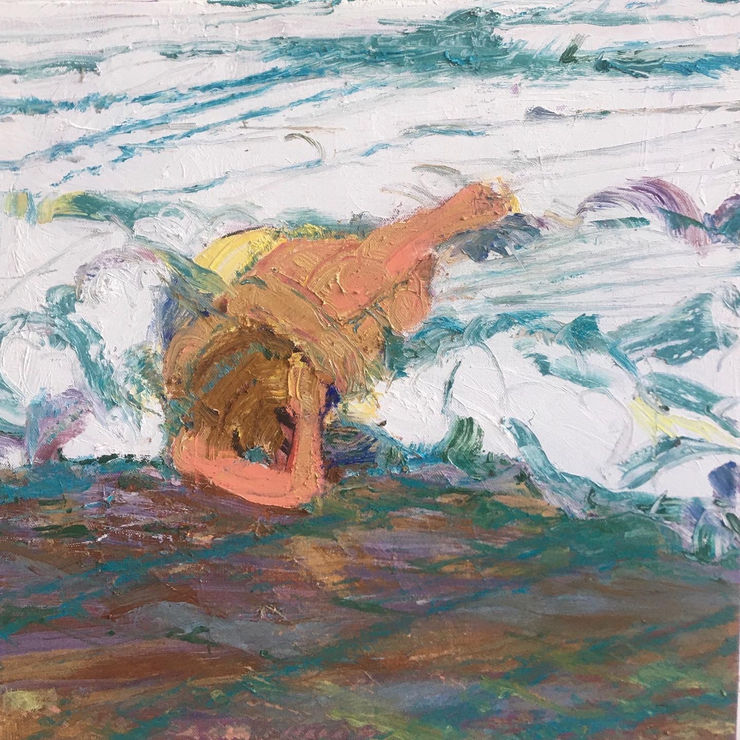
Swimmers 2007-2021 10 Sep - 7 Oct 2021 Catherine Lepp's Swimmers series arises from years of observing her children in the water: diving, coasting, surfing-and wiping out. Living for years as Lepp did with her husband Ray and sons Jake and Maxwell in a tiny Lower East Side apartment, the city's pools and beaches were an essential respite... Read more -
POLLOCK - OROZCO
27 Aug - 27 Sep 2021 Pollock - Orozco explores the visual dialogue between Jackson Pollock and José Clemente Orozco. I n 1936, Jackson Pollock traveled to Dartmouth College to view José Clemente Orozco’s mural, “The Epic of American Civilization.” These frescoes deeply impacted the young Pollock, as evidenced by the series of drawings and oil... Read more -
Jonathan Harkham
My Beloved Chogokin 22 Jul - 12 Aug 2021 Mark Borghi in Sag Harbor is pleased to present My Beloved Chogokin , an exhibition of recent works by Jonathan Harkham, on view July 22 - August 4, 2021. At the heart of Jonathan Harkham’s intensely worked and thickly gestural paintings and expressive drawings lie a passion for the experiential... Read more -
Benjamin King
Already There 11 - 30 Jun 2021 Mark Borghi in Sag Harbor is pleased to present an exhibition of paintings by Benjamin King, on view June 11 - June 30, 2021. Benjamin King’s landscape paintings are born from an improvisational process guided by intuition, in King’s words “like a hunting or tracking; discovering a narrative from trace... Read more -
Susan Carr
My Language 7 May - 7 Jun 2021 Mark Borghi in Sag Harbor is pleased to present an exhibition of recent work by Susan Carr, on view May 7 - June 7, 2021. As a lifelong learner, Susan Carr uses archetypes, metaphors, history, naivety and psychological ideas in her work. These motifs act as springboards for further investigation... Read more -
Gregory Coates: Reconstructed
2 - 30 Apr 2021 Mark Borghi in Sag Harbor is pleased to present Gregory Coates: Reconstructed , on view April 2 - April 30, 2021. Gregory Coates explores the possibility and nature of unorthodox material by juxtaposing various materials such as steel plates, cardboard, rubber hoses, duct tape, twine, feathers and paint into amalgams... Read more -
Clintel Steed: Behind the Hood
22 Jan - 12 Mar 2021 Mark Borghi in Sag Harbor is pleased to present new works by New York artist Clintel Steed in Behind the Hood , on view from January 22 - March 5, 2021 . Clintel Steed’s latest series of work is a response to the postponement of Philip Guston Now , the... Read more -
The Silence Perpetuates
A Survey of Important Black Artists 3 - 31 Jul 2020 Mark Borghi is pleased to present its inaugural exhibition in Sag Harbor with a survey of important Black artists. The gallery will donate 10 percent of sales from the exhibition to the United Negro College Fund. Featuring works by: Derrick Adams, Jean-Michel Basquiat, Chakaia Booker, Frank Bowling, Ed Clark, Gregory... Read more -
Compendium Part III
A Survey of Post War and Contemporary Art 3 - 31 Jul 2020 Mark Borghi is pleased to present Compendium Part III , a survey of Post War and Contemporary Art, in the Bridgehampton gallery. Compendium Part III provides a survey of major artworks produced during the twentieth century in the Americas and Europe, their theoretical justifications and critical receptions, from Abstract Expressionism... Read more -
Chakaia Booker: Art Miami 2019
3 - 8 Dec 2019 Mark Borghi is pleased to announce exclusive representation of Chakaia Booker with a solo presentation at Art Miami 2019. Chakaia Booker fuses ecological concerns with explorations of globalization, racial, economic, and gender differences by recycling discarded tires into complex abstract sculptures. Booker began to integrate discarded tires, residential, construction, and... Read more -
Compression
Andrew Wapinski 21 Mar - 3 May 2019 Mark Borghi is pleased to present, Compression , featuring recent works by the artist Andrew Wapinski. Born in Saint Clair Pennsylvania, Andrew Wapinski is a visual artist whose current practice is rooted in the memories of interacting with the environment of the historic coal mining town in which he grew... Read more -
Natalie Edgar: Paintings From the Last Decade
7 Feb - 15 Mar 2019 Mark Borghi is pleased to present works by the artist, Natalie Edgar in the New York gallery. Natalie Edgar’s work grows out of the transformative Abstract Expressionist milieu of which she was a part when, in studios scattered around the Village, unknown artists shifted the focus of the art world... Read more -
Wang Yigang: Recent works
8 Nov - 21 Dec 2018 Mark Borghi is pleased to present a solo exhibition, featuring fourteen paintings by the Chinese Abstract Expressionist artist, Wang Yigang. Born in 1961 in Qiqihar, China, Wang Yigang is one of the first generation of Chinese artists influenced by western art. In the 1970s and 80s, China started to build... Read more -
Voyage
Liz Doyle 20 Oct - 30 Nov 2018 Mark Borghi is pleased to present Voyage , featuring works by contemporary artist, Liz Doyle, in the Bridgehampton gallery. Hailing from a small island off the coast of County Donegal in the North West of Ireland, the artist notes how the horizon is a constant presence in her life. A... Read more -
Summerland
Alyssa di Edwardo 5 - 28 Sep 2018 Mark Borghi is pleased to present Summerland, featuring works by contemporary Abstract Expressionist artist, Alyssa di Edwardo. A contemporary Abstract Expressionist painter, Alyssa di Edwardo synthesizes landscapes into highly gestural compositions of strength and vulnerability. Her masterful use of color and intuitive palette have earned comparison to Joan Mitchell, Willem... Read more -
Compendium
A Survey of the last 75 years of Art History; Abstract Expressionism, Color Field, Minimalism and Pop Art 11 Aug - 3 Sep 2018 Mark Borghi Bridgehampton is pleased to present Compendium , a survey of the last 75 years of Art History; Abstract Expressionism, Color Field, Minimalism and Pop Art. This exhibition provides a survey of major artworks produced during the twentieth century in the Americas and Europe, their theoretical justifications and critical... Read more -
Lyrics & Form
Abstraction Expressionism and its Influence on Color Field Painters 1 - 31 Jul 2018 Mark Borghi is pleased to present Lyrics & Form: Abstraction Expressionism and its Influence on Color Field Painters, in the Bridgehampton gallery. As a reaction away from the gestural action painting of Abstract Expressionism, Color Field painting emerged focusing on how artists sought to create an authentic experience of pure... Read more -
InstaSelect
A Survey of International Artists 22 Feb - 30 Mar 2018 Mark Borghi is pleased to present InstaSelect a curated exhibition from our followers on Instagram. From Berlin to Lebanon, Vancouver to Stockholm and Los Angeles to New York, the exhibition features an international array of artists working in a variety of materials. Both emerging and established artists are showcased challenging... Read more -
MOVING TARGETS: AMERICAN ART FROM 1918-2012
1 - 30 Jul 2017 MOVING TARGETS looks anew at relationships, influences, and two-way exchanges between historic and contemporary American Artists. The lines of academic and modernist influence from Europe to the United States can be traced in the field’s early days, by such artists as Stuart Davis and Marsden Hartley. The course that was... Read more -
MERCEDES MATTER: A Survey: Paintings & Drawings from 1929 to 1998
6 Apr - 26 May 2017 This is the first solo show of the late artist at Mark Borghi Fine Art. The exhibition is a mini retrospective of the traveling museum show of Mercedes Matter’s estate represented by Mark Borghi, which was on view at Baruch College, New York, NY, Pepperdine University, Malibu, CA, Guild Hall... Read more